Tel: +86-183-6396-1712 E-mail: bruce@luckywaycn.com
English

Views: 0 Author: Site Editor Publish Time: 2026-03-05 Origin: Site


In Southeast Asia, sulfuric acid transportation is a “no second chances” operation. The climate is hot and humid, monsoon rains can be sudden and intense, and coastal routes add salt-laden air that accelerates corrosion. At the same time, logistics realities—mixed road conditions, frequent stops, long-haul vibration, and busy loading bays—put continuous stress on fittings, valves, gaskets, and weld seams. In this environment, a sulfuric acid tanker trailer isn’t judged only by capacity or paint quality. It’s judged by one core requirement: leak prevention, every day, under real conditions.
Sulfuric acid is highly corrosive, and even small leaks can damage equipment, pavements, and safety systems. In Southeast Asia, several factors increase leakage risk:
Heat + daily temperature swings can stress seals and joints (expansion and contraction)
High humidity increases condensation risks in protected areas and accelerates corrosion on external parts
Monsoon rain increases water exposure at manways, valve cabinets, and hose connections
Coastal salt air attacks external hardware, fasteners, and protective coatings
Road vibration and uneven surfaces loosen fittings and amplify fatigue at brackets and pipe supports
Busy loading/unloading rhythms raise the chance of impact damage, cross-threading, and poor reconnection
So the anti-leak goal is two-layered:
Prevent leakage in the first place
If something goes wrong, contain it and detect it quickly
Most leaks originate from a short list of “interfaces”:
Manway cover, bolts, and gasket
Top loading fittings and vent connections
Bottom outlet valve, piping elbow, and flange joints
Hose connection point and couplers
Instrument ports (level gauge/nozzles), sampling ports
Drain points and low-point fittings
Weld seams around nozzles, brackets, and reinforcements
A strong trailer design assumes these areas will be stressed and protects them accordingly.
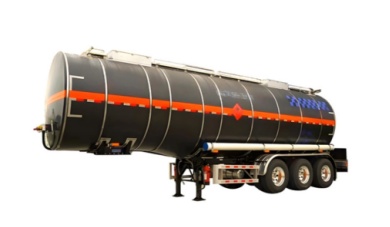
Anti-leakage starts with choosing materials that resist sulfuric acid under the intended concentration and operating conditions. The “right” material depends on the chemical concentration, temperature, and contamination profile—so we recommend treating material selection as an engineering decision, not a habit.
Key anti-leak principles:
Use proven tank materials for the intended sulfuric acid concentration range
Apply corrosion allowance where appropriate (design margin for long service life)
Avoid mixed-metal joints that create galvanic corrosion risk at external interfaces
Ensure external hardware and supports also resist the climate (not just the inner shell)
Why this matters: If corrosion attacks a nozzle neck or valve housing from the outside, you can still get leakage even if the tank shell is thick.
Weld quality is a primary anti-leak factor, but design matters too.
Essential practices:
Reinforced pads around nozzles and manways to distribute stress
Smooth internal transitions to reduce turbulence and localized erosion
Proper support design for piping so welds don’t carry vibration loads
In Southeast Asia, vibration and frequent braking/acceleration cycles amplify fatigue. Reinforcement and proper bracketing reduce micro-cracking risk over time.
Leaks often come from “good parts installed poorly,” especially at manways and flanges.
Anti-leak essentials:
Acid-compatible gaskets selected for chemical resistance and temperature range
Proper bolt patterns and controlled torque approach to avoid uneven compression
Protection against bolt corrosion (external environment matters)
Design that makes correct assembly easy and repeatable for operators
Practical note: In real operations, the best sealing design is the one that still seals well even when the environment is wet and the team is working fast.
For sulfuric acid, the discharge system deserves special attention.
Recommended anti-leak approach:
Primary shut-off valve designed for chemical service
A secondary isolation point (where the system design allows) to reduce risk during maintenance or hose changes
Protected valve position to reduce impact damage from road debris
Clear drain/bleed management (designed to minimize residual chemical at disconnection)
Bottom outlet areas are common leak zones because they are exposed to:
impact, vibration, and debris
frequent operation during unloading
flange stress from hose weight and operator handling
Many leakage incidents happen not on the tank body—but during loading/unloading.
Essential anti-leak features:
Stable connection geometry that prevents misalignment
A coupling strategy designed to reduce drips at disconnection (where feasible)
Mechanical support for hose loads so the valve flange isn’t acting like a “hanger”
Clear operator access and visibility (operators should not fight awkward angles)
If a connection point is hard to reach, it will be handled roughly. If it’s handled roughly, seals will degrade faster.
A tanker must handle pressure changes safely. Temperature swings and operational processes can create pressure/vacuum conditions that stress seals.
Anti-leak pressure management includes:
Proper venting design that prevents unwanted pressure buildup
Pressure relief solutions suited to chemical service
Design that prevents rainwater intrusion through vents during monsoon conditions
Placement that avoids splash and direct water entry paths
Good venting isn’t only about safety—it reduces seal stress and helps prevent seepage at gaskets.
Even with strong design, buyers in Southeast Asia often prioritize containment features to reduce consequences if a minor leak occurs.
Useful containment ideas include:
Valve box/cabinet with containment logic (where applicable)
Drainable collection areas designed to prevent spreading
Protected routing so any seepage does not spray onto tires or brakes
Clear inspection access so small seepage is found early
Containment is not a substitute for quality—it’s an additional protection layer.
Leak Risk Area | Why It Leaks in Real Life | Anti-Leak Design That Helps |
Manway gasket | uneven bolt compression, aging gasket, rain exposure | correct gasket spec, corrosion-resistant fasteners, torque-friendly pattern |
Nozzle weld zone | vibration fatigue, stress concentration | reinforcement pads, proper pipe supports, verified weld quality |
Bottom outlet | impact + vibration + frequent use | protected placement, robust valve selection, secondary isolation concept |
Hose connection | misalignment, hose weight, fast disconnect | stable coupling geometry, hose support bracket, drip-control approach |
Flange joints | bolt corrosion, uneven tightening | suitable gasket + bolts, anti-corrosion design, easy access for correct assembly |
Vent/relief | pressure cycles + rain intrusion | correct venting layout, weather protection, chemical-compatible components |
A trailer can look perfect and still leak if QA is weak. We suggest buyers ask about verification practices that reduce leak risk, such as:
Weld inspection approach (process control + inspection)
Pressure/vacuum integrity checks at the manufacturing stage
Fit-up control for nozzles and flanges (misalignment causes gasket failure)
Traceability for key components (valves, gaskets, critical fittings)
Buyer mindset: anti-leak design is not only “what parts are used,” but also “how consistently they are assembled and verified.”
In Southeast Asia, where humidity and dust are persistent, good design should make inspection easy:
Clear sightlines to valve and flange areas
Access doors placed logically (not blocked by structure)
Simple “pre-trip” inspection points that operators can check quickly
Corrosion-resistant external hardware that doesn’t seize after one season
If inspection is difficult, it will be skipped. If it’s skipped, small seepage becomes a larger problem.
So, what anti-leakage designs are essential for sulfuric acid tank semi-trailers in Southeast Asia? The essentials are not one “magic valve” or one thicker plate. They are a system: correct material strategy, reinforced nozzle and weld design, reliable gasket compression control, protected discharge architecture (often with layered isolation thinking), coupling and hose-load management, proper venting/pressure control, and practical containment plus inspection access that fits monsoon and coastal realities.
At Qingdao Xingjiayun International Trade Co., Ltd., we approach sulfuric acid tanker trailer selection with this system mindset, helping buyers focus on the real leak points and the design details that keep operations stable in Southeast Asia’s demanding climate and logistics conditions. If you’re evaluating a sulfuric acid tanker trailer project and want support clarifying anti-leak requirements, configuration options, and practical procurement specifications, you’re welcome to learn more and contact Qingdao Xingjiayun International Trade Co., Ltd. for further information.
In many real-world cases, leaks start at interfaces—manway gaskets, flange joints, bottom outlet valves, and hose connections—rather than the main tank shell.
Rough roads, debris, and frequent unloading cycles increase impact and vibration stress at the bottom outlet area, making protective placement and robust valve design essential.
Heat cycles stress seals, humidity accelerates corrosion, and monsoon rain challenges venting and cabinet sealing—so designs must handle water exposure and temperature swings reliably.
Ask how welds and joints are verified (integrity testing, inspection practices), and confirm component traceability for valves, gaskets, and critical fittings used in the sulfuric acid tanker trailer.


