Tel: +86-183-6396-1712 E-mail: bruce@luckywaycn.com
English

Views: 0 Author: Site Editor Publish Time: 2026-02-06 Origin: Site


Most loads land in a practical range. Think 6 to 9 cars on a Car Carrier Semi Trailer. It depends on vehicle size. It depends on trailer style. It also depends on route limits.
Compact sedans: 8 to 9 cars can work often.
Mixed sedans and crossovers: 7 to 8 cars feels common.
Mostly SUVs or vans: 5 to 7 cars is more realistic.
| Carrier style | Common planning range | Why it changes |
|---|---|---|
| Open standard Car Carrier Semi Trailer | 6–9 cars | Deck layout, vehicle mix |
| High-mount / conventional | 7–8 cars | Height envelope, deck geometry |
| Higher-capacity configurations | 8–11 cars (sometimes) | Design allowances, smaller vehicles, strict planning |
Russia changes the math fast. Height and length limits matter. Bigger SUVs reduce count quickly. So we plan using the vehicle list first.
Want to compare carrier options for your fleet? Start at www.luckywaycn.com.
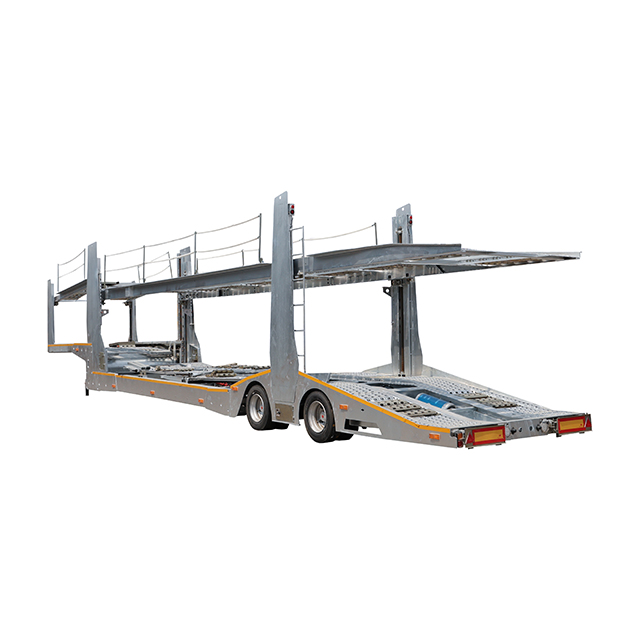
A Car Carrier Semi Trailer transports passenger vehicles using ramps and decks. It can be open or enclosed. It can use fixed decks or hydraulic decks. People also call it an auto carrier semi trailer. Some call it a car transporter semi trailer. Same job, different words.
Car Carrier Semi Trailer
car transporter semi trailer
auto carrier semi trailer
vehicle transport semi trailer
car hauler semi trailer
Upper and lower decks for stacking vehicles.
Ramps or tilting platforms for loading.
Hydraulic controls for deck angle and height control.
Tie-down points, winches, wheel straps.
It looks simple. Small geometry differences change capacity a lot. So we always check deck length and maximum deck height.
In Russia, legal limits shape everything. They cap height, width, and length. Even a perfect load plan can fail if it exceeds the envelope.
Overall height: it often becomes the first constraint.
Overall width: it matters for wide SUVs and mirrors.
Overall length: it limits deck count and overhang.
| Limit type | Why it matters | What it affects |
|---|---|---|
| Height envelope | Bridges and overhead clearance | Upper deck positions, SUV stacking |
| Width envelope | Lane control and safety margins | Side spacing, mirror planning |
| Length envelope | Turning, legal combination limits | Total deck length, number of cars possible |
Even if nine cars fit physically, it can be illegal by weight. SUVs and EVs weigh more. It pushes axle loads faster. We then drop one or two vehicles, even if space remains.
Some loads require permits. It depends on local enforcement and route. If the load exceeds height, width, or length limits, it may trigger permit needs. This is why dispatchers ask for exact vehicle models.
Carrier design drives capacity. It decides deck count, loading angles, and usable length. It also decides how easy it is to stay within limits.
Open carriers are common. They load faster. They also maximize usable deck space. Most planning starts at 6 to 9 cars. Then the vehicle mix decides the final number.
This style feels stable and familiar. Many fleets use it. Capacity often tops out near eight cars under typical conditions. It can be less when SUVs dominate.
Some designs carry more cars in some markets. You may see 9 to 11 claims. Russia constraints can limit those numbers. Clearance and length rules can reduce them quickly.
Enclosed carriers protect paint and interiors. They also reduce capacity. It is a trade. They make sense for premium cars and long winter routes.
You can estimate capacity before the truck arrives. It saves time. It reduces rework. We do it using a simple step method.
Pick the carrier type. Open, conventional, or enclosed.
List vehicle lengths, heights, weights. Use real spec sheets.
Check the legal envelope for your route. Height becomes critical.
Plan deck positions. Put tall vehicles on lower deck positions.
Review axle distribution. Avoid loading heavy vehicles on one end.
| Vehicle mix | Typical planning count | Why |
|---|---|---|
| Mostly compact sedans | 8–9 cars | Low height, shorter length, lighter weight |
| Mixed sedans + crossovers | 7–8 cars | Height and weight start to constrain |
| Mostly SUVs / vans | 5–7 cars | Height envelope and axle loads limit sooner |
Tall SUVs push the overall height too high.
Wide vehicles reduce safe side clearance space.
Heavy vehicles hit axle loads earlier.
Bad mix forces wasted deck space.
Route restrictions reduce allowable envelope.
When you share your vehicle list, we can help you estimate a safe count. It reduces surprises. Browse models on Products.
We all want more cars per trip. Nobody wants damage or fines. So we load like pros. It starts using sequencing and height control. It ends using stable tie-down habits.
Load the heaviest vehicles first. It stabilizes the rig early.
Put the tallest units on the lowest deck positions.
Use low-roof sedans on upper deck slots.
Pair short wheelbase cars near ramps. It reduces wasted angle space.
Alternate nose-to-tail directions. It shortens gaps.
Height becomes the first limiter in Russia. You can often “fit” one more vehicle. You still may exceed clearance. We avoid it using deck angles, not luck.
Drop the upper deck angle slightly. It lowers rooflines.
Avoid stacking two tall SUVs in the highest front zone.
Remove or fold antennas. Secure them inside the car.
Check roof racks, spoilers, light bars. They add centimeters fast.
Measure total height after loading. Do it before dispatch.
Space is one constraint. Weight is another. A Car Carrier Semi Trailer can look fine and still break axle limits. We spread weight across the length. It keeps steering stable. It also keeps braking predictable.
| Where weight concentrates | What happens | What we do |
|---|---|---|
| Too much weight up front | Steering axle risk, rough ride | Move heavy SUVs lower, shift rearward |
| Too much weight at the rear | Trailer axle overload, sway risk | Balance heavy units across mid positions |
| Uneven side loading | Lean, tie-down stress | Mirror vehicle weights left and right |
Use wheel straps or approved tie systems. Avoid body hooks.
Check strap tension after 30–50 km. They settle.
Protect paint contact zones using soft sleeves or pads.
Secure loose parts. Mirrors, spoilers, trim pieces, wipers.
Russia adds real-world friction. Weather changes fast. Roads vary a lot. Clearance signage can appear late. So we plan route and season, not only trailer capacity.
Bridge heights and overhead signs on the planned corridor.
Urban turns and roundabouts. Length matters there.
Border or region checkpoints. They can enforce envelopes.
Loading and unloading zones. Surface grip matters.
Snow and ice change everything. Ramps get slippery. Brake distance grows. We adapt using slower loading, more checks, and anti-slip routines.
Use anti-slip ramp mats or gritted surfaces.
Reduce loading angle when ice risk rises.
Check tire pressures and strap stiffness in cold.
Plan extra time for safe unloading.
If your loaded Car Carrier Semi Trailer exceeds local limits on height, width, or length, permits may apply. It varies by region and route. We treat it as a route compliance question, not only a trailer question.
Vehicle mix decides your final count. It also decides damage risk. We group loads using height and weight buckets. It keeps planning simple.
These loads often hit higher counts. They are low. They are lighter. You can often plan 8 to 9, depending on deck geometry.
They reduce count quickly. Height and weight become constraints. Many fleets plan 6 to 8 on mixed loads. If the list is mostly SUVs, 5 to 7 is safer.
These reduce count the most. They can break height envelopes early. They also push axle loads faster. Measure first. Plan second.
Mixed loads are common. They can still be efficient. We just need a plan. Use a simple mix template.
| Vehicle | Type | Length | Height | Weight | Planned deck position |
|---|---|---|---|---|---|
| Car 1 | Sedan | — | — | — | Upper middle |
| Car 2 | SUV | — | — | — | Lower front |
| Car 3 | Crossover | — | — | — | Lower rear |
Car count affects cost per vehicle. More cars usually lower the cost per car. It holds until risks rise. Damage claims erase savings fast. So we aim for “safe max,” not “paper max.”
Distance and fuel price swings.
Tolls and regional fees on the route.
Extra handling time for complex loads.
Permits, escorts, plus compliance delays.
Return load availability. Empty miles hurt profits.
| Scenario | Cars loaded | Operational risk | Cost per car trend |
|---|---|---|---|
| Mostly sedans, good route | 8–9 | Lower | Lower cost per car |
| Mixed sedans + SUVs | 7–8 | Medium | Moderate cost per car |
| Mostly SUVs, winter route | 5–7 | Higher | Higher cost per car |
If you buy a Car Carrier Semi Trailer for Russia, focus on controllability. Height management matters. Axle rating matters. Ramp safety matters. It makes your daily work easier.
Adjustable deck heights and angles for clearance control.
Strong, reliable hydraulics. It saves time.
Axle configuration aligned to your expected vehicle weights.
Reinforced ramps and anti-slip surfaces for winter use.
Enough tie-down points for mixed vehicle footprints.
| Option | Why people choose it | Typical trade |
|---|---|---|
| Open Car Carrier Semi Trailer | Higher capacity, faster loading, lower cost | More exposure to weather and road debris |
| Enclosed Car Carrier Semi Trailer | More protection, premium vehicle transport | Lower capacity, higher purchase and operating cost |
Can it keep legal height using your usual vehicle mix?
Can it handle heavier EVs and SUVs safely?
Does it provide clear specs on dimensions and axle ratings?
Is maintenance access simple for your service team?
For a real example spec sheet, see the Double-Deck Euro-Style Car Carrier Semi Trailer page.
Most operators plan 6 to 9 cars. The legal answer depends on height, length, and weight limits on the route. Vehicle mix matters more than the trailer’s advertised maximum.
No. Eight is common for many conventional carriers. Smaller cars can reach nine. SUV-heavy lists often drop the count to six or seven.
Sometimes, using higher-capacity designs and small vehicles. Route constraints can reduce it fast. Clearance and length rules often become limiting.
They increase height and weight. It forces lower deck placement. It also reduces upper deck options. Many loads drop by one or two vehicles.
Use a deck plan. Put tall cars low. Use low cars on top. Balance weight. Strap correctly. Recheck tension after the first stretch of driving.
Open carriers fit higher capacity and lower cost. Enclosed carriers fit premium vehicles and extra protection. Many fleets run open carriers for volume, enclosed for special orders.
So, how many cars can a Car Carrier Semi Trailer load in Russia? Most of the time, it is 6 to 9 cars. Smaller cars can push higher. SUVs and winter routes push lower. Plan using vehicle dimensions, weight, and route clearance. It keeps operations safe and efficient.
Want higher count? Use better mixing and height planning.
Want fewer claims? Use correct tie-down habits and checks.
Want the right trailer? Choose specs built for your routes.


