Tel: +86-183-6396-1712 E-mail: bruce@luckywaycn.com
English

Views: 0 Author: Site Editor Publish Time: 2026-07-03 Origin: Site


Central Asia is experiencing a massive surge in infrastructure, energy, and mining projects. Regional development initiatives drive high demand for reliable logistics across vast territories. Transport operators face severe operational realities on these inland road networks. Standard flatbeds and stock trailers suffer from premature structural fatigue. Ground clearance failures and maneuverability limitations plague fleets navigating unpaved steppes, mountain passes, and degraded asphalt in Kazakhstan and Uzbekistan. Successful heavy equipment transport along these challenging inland trade routes requires a highly customized Lowbed Semi Trailer. Standard units simply break under the stress of these environments. This guide provides fleet managers with a technical framework. You will learn how to evaluate chassis strength, axle configurations, and loading mechanisms specifically suited for Central Asian terrain. We focus on practical engineering solutions that keep fleets moving and prevent catastrophic equipment failures in remote locations.
Chassis Durability is Non-Negotiable: High-yield strength steel (e.g., Q690D) is required to withstand the severe torsional stress of rough road heavy haul trailer operations without adding excessive tare weight.
Suspension Dictates Survival: Multi-axle configurations with robust mechanical or hydraulic suspensions are critical for load distribution and stability on uneven surfaces; air suspensions present high maintenance risks in remote steppes.
Loading Mechanisms Impact Safety: Choosing between a removable gooseneck lowbed and a hydraulic ladder system depends on the specific machinery being transported and the availability of flat loading ground.
Remote-Control Integration Prevents Injury: Incorporating remote-controlled hydraulic ladders reduces operational hazards when loading heavy machinery on unstable or off-road sites.
Compliance Drives Configuration: Axle spacing and tire selection must balance off-road capability with strict cross-border weight, height, and route regulations across Central Asian jurisdictions.
Central Asian routes present severe environmental stressors for heavy transport equipment. Extreme seasonal temperature fluctuations pose immediate risks to structural integrity. Winter temperatures frequently drop below -40°C, increasing the risk of brittle steel fractures in standard chassis components. Summer heat softens asphalt, creating deep ruts under heavy loads. Unpaved roads dominate the remote mining and energy sectors. Steep gradients in mountainous transit corridors demand exceptional braking and traction capabilities. Trailers must endure constant vibration and high-impact shocks from potholes and washboard gravel surfaces. When you haul an 80-ton transformer across the Pamir Highway, the constant lateral and vertical forces test every weld on the frame. Mud during the spring thaw creates suction that can literally tear weak axles from their mounts.
Transport corridors connecting Western China, Kazakhstan, and Uzbekistan dictate strict equipment standards. Cross-border logistics require fleets to maintain high reliability across variable road qualities. Border inspections frequently target overloaded or structurally compromised vehicles. A specialized Central Asia lowbed trailer must navigate these diverse jurisdictions seamlessly. Inconsistent infrastructure development means a single route may feature pristine highways and severely degraded dirt tracks. Fleet operators must specify trailers capable of handling both extremes without requiring mid-route modifications. You cannot stop to reinforce a deck or change suspension settings when you are 300 kilometers from the nearest paved town.
Successful cross-border transit depends heavily on strict dimensional compliance. Overall height restrictions dictate trailer deck height across different national borders. You must balance protecting cargo from bridge strikes with maintaining sufficient ground clearance. Low bridges and overhead power lines are common hazards on older inland routes. Lowering the deck height solves overhead clearance issues but increases the risk of bottoming out on rough terrain. Engineering the correct deck height requires analyzing specific route constraints and the dimensions of your typical payload. We often see operators miscalculate the dynamic bounce of the trailer, leading to catastrophic bridge strikes even when static measurements looked fine.
Advanced repair facilities are virtually nonexistent along many inland routes. This lack of infrastructure establishes a strict requirement for mechanical simplicity. Standardized wear parts and high reliability in trailer components prevent catastrophic downtime. A breakdown in the remote steppes means days of waiting for recovery vehicles. Complex electronic systems often fail in dusty, high-vibration environments. Operators must prioritize field-repairable mechanical systems over highly complex, proprietary technologies. Readily available bearings, brake linings, and suspension components keep fleets moving. If your driver cannot fix a broken leaf spring with a basic toolkit and a jack, that trailer does not belong in Central Asia.
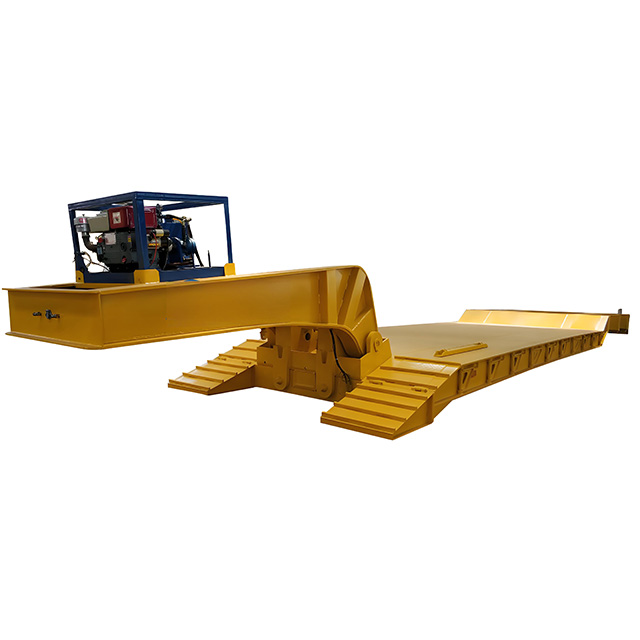
High-tensile steel main beams are mandatory for inland heavy transport. Standard carbon steel bends or fractures under the torsional stress of uneven roads. Materials like Q690D high-yield steel provide the necessary strength without adding excessive tare weight. You must evaluate the trade-offs between rigidity and flex. A completely rigid chassis will crack when navigating deep ruts with an 80-ton payload. The frame must allow controlled flexing to absorb ground irregularities. Continuous submerged arc welding on the main beams prevents stress concentrations and weld fatigue. We inspect these welds using ultrasonic testing to ensure zero internal voids. A single slag inclusion in a main beam weld will propagate into a full structural failure after a few months on washboard roads.
Lowering the center of gravity improves stability for tall machinery. However, this creates an engineering challenge on unpaved roads. The trailer belly must not bottom out on rocks or deep mud ruts. Engineers achieve this balance through specialized gooseneck drops and tailored tire selections. The working deck must remain flat and heavily reinforced. Ground clearance should typically exceed 250mm under full load. Adjustable suspension systems can temporarily raise the deck height to clear specific obstacles during off-road transit. When designing the deck, we also incorporate heavy-duty outriggers to temporarily widen the platform for oversized tracked excavators, ensuring the tracks are fully supported.
The gooseneck absorbs massive dynamic shock loads transferred from the tractor unit. Rough-road transit multiplies these forces exponentially. Standard goosenecks often develop stress fractures at the transition point to the main deck. A reinforced design utilizes thicker web plates and additional gussets at critical stress points. The kingpin plate must withstand aggressive coupling angles on uneven ground. Heavy-duty bracing prevents the gooseneck from twisting when the tractor and trailer sit on different lateral planes. We mandate a minimum of 16mm thickness for the lower flange of the gooseneck to handle the severe upward thrust encountered when cresting steep mountain passes.
Specialized transport scenarios require localized deck reinforcement. Transporting 12-ton dump trucks or secondary semitrailers places extreme point loads on the deck. Standard wooden decking will crush under these concentrated wheel loads. Steel checker plate with underlying cross-member reinforcement is necessary. Specialized tie-down points must align with the axles of the loaded vehicles. Ramp angles must accommodate the approach angles of nested trucks to prevent bumper damage during loading. Structural bowing is a primary failure mode when carrying heavy wheeled payloads. To combat this, we space the lateral cross-members at a maximum of 300mm intervals in the primary load zones.
Steel Grade Comparison for Heavy Haul Chassis | |||
Steel Grade | Yield Strength (MPa) | Cold Weather Performance (-40°C) | Application Suitability |
|---|---|---|---|
Q345 (Standard) | 345 | Poor (High fracture risk) | Light duty, paved roads only |
Q460 | 460 | Moderate | Medium duty, mixed terrain |
Q690D | 690 | Excellent (Maintains ductility) | Heavy duty, severe off-road |
Spreading heavy payloads across multiple axles prevents overload penalties at border crossings. Common configurations include 4-axle, 5-axle, and 6-axle setups. Multi-axle systems reduce the ground pressure exerted by each tire. This prevents the trailer from sinking in soft mud or sand. A well-designed rough road heavy haul trailer utilizes these axles to distribute the load evenly. Proper weight distribution protects the trailer chassis and the road surface. It also ensures the tractor unit maintains sufficient traction on steep inclines. When you lose traction on a 12% gravel grade, the entire rig can slide backward. Proper axle placement keeps the drive axles of the truck planted firmly.
Suspension choice dictates trailer survival in remote areas. Heavy-duty mechanical leaf spring suspensions offer ruggedness and ease of field repair. Broken leaf springs can be replaced with basic hand tools. Hydraulic suspension systems provide active load leveling on severe lateral inclines. They distribute weight evenly across all axles, regardless of ground contour. Standard pneumatic air suspensions present high maintenance risks. Air bags puncture easily on debris and are difficult to repair in the steppes. Mechanical and hydraulic systems remain the standard for inland routes. We strongly recommend a 13-ton or 16-ton rated mechanical suspension with thickened leaf springs (minimum 10 leaves) for maximum durability.
Integrating smaller, high-load-bearing tires reduces the overall deck height. This modification directly addresses overhead clearance restrictions. Smaller tires rotate faster and generate more heat. They require robust multi-axle configurations to maintain load capacity. Self-steering or hydraulically steered axles are necessary to navigate tight mountain switchbacks. Steerable axles drastically reduce tire scrub and chassis stress during tight turns. This extends tire life and improves maneuverability in confined off-road loading sites. We often specify 235/75R17.5 or 245/70R17.5 tires with a high ply rating to handle the sharp rocks common in mining environments.
Inspect all suspension U-bolts for proper torque after the first 500 kilometers of rough road travel.
Grease all equalizer pins and steering linkage joints daily when operating in dusty environments.
Check tire pressures cold every morning, adjusting for the massive temperature swings between night and day.
Visually inspect hydraulic suspension lines for abrasion where they route through the chassis cross-members.
A removable gooseneck lowbed provides front-loading capability. This creates the lowest possible incline angle for machinery. It is essential for the safe loading of heavy tracked equipment like excavators and bulldozers. Front-loading prevents tipping hazards associated with steep rear ramps. The primary drawback is the requirement for a flat, stable area to detach and attach the gooseneck. Muddy or heavily sloped ground complicates the coupling process. RGN trailers also carry a higher upfront manufacturing cost due to complex locking mechanisms. Operators must keep the locking pins heavily greased and free of ice buildup during winter operations.
A hydraulic lowbed trailer features heavy-duty rear ramps. Remote-controlled hydraulic rear ladders allow operators to maintain a safe distance during deployment. This reduces operational hazards on unstable off-road sites. Rear loading allows rapid deployment without detaching the tractor unit. The main disadvantage is the steeper loading angle. Tracked machinery can slip on wet steel ramps. The hydraulic power pack requires regular maintenance. Hydraulic fluids must be properly winterized to function in extreme Central Asian cold. We weld heavy steel traction bars horizontally across the ramps to give steel tracks something to bite into during wet conditions.
Drivers must follow strict protocols when transitioning from smooth highways to unpaved sites. Speed reduction is the first critical step to prevent suspension damage. Operators must perform manual load securement checks before entering rough terrain. Chains and binders loosen under heavy vibration. Drivers should manually adjust hydraulic ramp locking pins to ensure they remain secure. Ground spotters are necessary when navigating deep ruts to prevent high-centering the trailer belly. Proper transition protocols prevent cargo shifts and structural damage. We train drivers to lock the steering axles before reversing into a tight dirt loading bay to prevent the linkage from binding.
Procurement teams face a direct trade-off between initial capital expenditure and operational reliability. Over-specifying a trailer increases the upfront purchase price. Under-specifying guarantees catastrophic structural failure on inland routes. Cargo damage and high recovery costs in remote areas quickly erase any initial savings. Investing in high-yield steel and reinforced suspensions prevents costly downtime. A stranded 80-ton transformer in the mountains creates logistical nightmares. Prioritize structural integrity and reliable components over budget-grade standard trailers. You are buying insurance against the harshest roads on the continent.
Highly adapted heavy haul trailers require longer manufacturing lead times. Off-the-shelf units rarely meet the specific demands of Central Asian terrain. Custom engineering, specialized steel procurement, and complex welding procedures add weeks to production schedules. Fleet managers must plan procurement cycles well in advance of project start dates. Rushing production often leads to compromised weld quality and skipped quality control checks. Factor these extended lead times into your overall project logistics planning. We recommend initiating the design phase at least four months before the required delivery date.
Specifying standard, widely available wear parts ensures fleet uptime. Brake linings, wheel bearings, and hydraulic seals must be easily sourced across transit routes. Proprietary components trap operators into relying on slow international shipping for basic repairs. Work with manufacturers who utilize globally recognized axle and suspension brands. Standardized parts allow local mechanics in Kazakhstan or Uzbekistan to perform routine maintenance. This strategy drastically reduces downtime and keeps heavy equipment moving toward project sites. Always carry a spare set of wheel bearings and a complete air brake valve kit in the tractor unit.
Audit your current heavy equipment dimensions and weights to determine minimum payload requirements before contacting a manufacturer.
Map your primary transit routes to identify specific height restrictions, bridge capacities, and off-road terrain challenges.
Request Finite Element Analysis (FEA) reports from the manufacturer to verify the chassis can handle dynamic shock loads.
Draft exact technical specifications tailored to regional axle-load regulations in consultation with a specialized trailer engineer.
A: The ideal deck height balances bridge clearance with rough-road ground clearance. Operators typically aim for 850mm to 1000mm. This height accommodates tall machinery under strict cross-border height rules while preventing the chassis from bottoming out on unpaved steppes. Tire size and suspension type directly influence this measurement.
A: Front-loading tracked machinery provides the lowest possible incline angle. This prevents heavy equipment like bulldozers and excavators from tipping backward during loading. It eliminates the risks associated with climbing steep rear ramps, making it the safest option for unstable mining sites.
A: Standard air suspensions present high risks on unpaved inland routes. Air bags puncture easily on sharp rocks and debris. Repairing pneumatic systems in remote areas is difficult due to a lack of parts and compressed air. Mechanical or hydraulic suspensions are preferred for their durability.
A: A 6-axle trailer typically handles payloads ranging from 80 to 120 tons. The exact capacity depends on the tractor's towing rating, the trailer's steel yield strength, and local bridge weight laws. Multi-axle setups distribute this massive weight to comply with border regulations.
A: Smaller tires lower the overall deck height, allowing fleets to transport taller cargo under low bridges. However, they have lower individual weight capacities. Manufacturers must use multi-axle configurations to maintain the total load-bearing capacity required for heavy machinery.
A: Temperatures dropping below -40°C cause standard hydraulic fluids to gel, leading to system failure. Trailers require winterized hydraulic fluids, insulated lines, and high-quality cold-weather seals. Proper winterization ensures remote-controlled ladders and steering systems function safely in freezing conditions.
A: Yes, but they require specific modifications. Transporting heavy wheeled vehicles like 12-ton dump trucks places concentrated point loads on the deck. The trailer must feature reinforced steel checker plate decking, specialized tie-down points, and appropriate ramp angles to prevent structural bowing.


