Tel: +86-183-6396-1712 E-mail: bruce@luckywaycn.com
English




| Quantity: | |
|---|---|
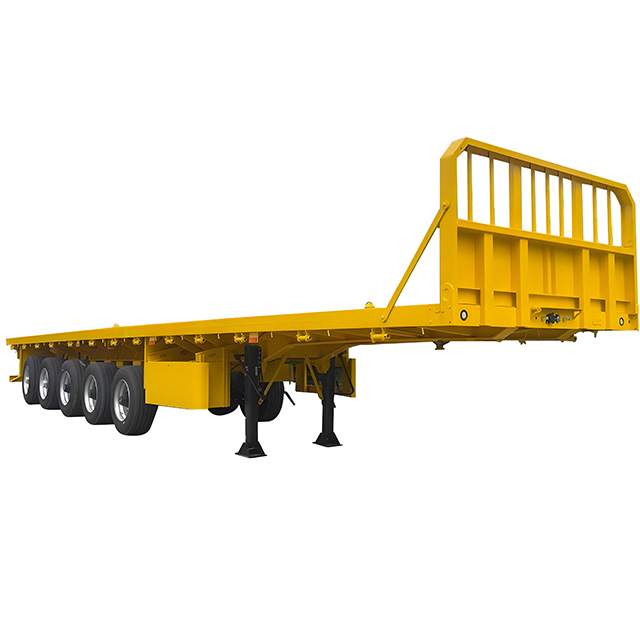
The Flatbed Semi Trailer is a workhorse in logistics, designed to transport oversized, irregularly shaped, or heavy cargo that cannot fit in enclosed trailers—such as construction machinery (excavators, bulldozers), steel beams, prefabricated building components, and large industrial equipment.


Loading Capacity | 30-80 tons |
Sidewall | Optional |
Axle | 3/4/5 pcs |
Tire | 12/16/20 units |
Material | Carbon steel Q345/T700 |
Twist Lock Type | 4 pcs or 8 pcs or 12 pcs or customized container lock |
Flatbed Semi Trailers’ open-top, side-less design allows unrestricted access from the top, sides, and rear, making it ideal for loading with cranes, forklifts, or overhead hoists. Built with high-strength carbon steel (Q345/T700), this trailer balances durability and load capacity, supporting 30–80 tons of payload. It is a staple for industries like construction, manufacturing, and heavy equipment rental, where flexibility and efficiency are critical.
Unlike enclosed trailers, the Flatbed Semi Trailer has no sidewalls or roof, eliminating size restrictions for cargo. This design enables vertical loading (via crane) for tall items (e.g., 10m steel columns) and side loading (via forklift) for long materials (e.g., 15m pipes). The flat cargo surface (with a 5mm–8mm steel plate) is also customizable with anti-slip coatings to secure loose cargo.
The trailer’s main frame uses 300mm–400mm high I-beams (Q345 steel), which distribute weight evenly across the 3/4/5-axle system. This structure resists bending even when carrying unevenly weighted cargo (e.g., a single 80T excavator). The twist lock system (4/8/12 units or custom) further secures containers or modular cargo, preventing shifting during transport.
Customers can choose from 12–20 heavy-duty tires (based on payload) and optional sidewalls (removable mesh or steel panels) for light bulk cargo (e.g., gravel). The trailer’s length (10m–16m) is also customizable to fit regional road length limits, ensuring compliance with local transport laws (e.g., EU’s 16.5m maximum length).
Construction companies often need to move heavy equipment between job sites. The Flatbed Semi Trailer’s 80T capacity accommodates large excavators (e.g., CAT 336) or bulldozers, while its open design allows easy loading via ramps or cranes. The twist lock system secures the machinery’s tracks, preventing movement during highway transport—reducing the risk of damage to the equipment or other vehicles.
Steel manufacturers and prefabricated building firms transport long, heavy materials (e.g., H-beams, concrete panels). The trailer’s flat surface and customizable length (up to 16m) fit 12m–15m steel bars, while optional side rails prevent rolling. For fragile prefabricated walls, we add foam padding to the cargo bed, ensuring no cracks or dents during transit.
Factories moving large machinery (e.g., printing presses, turbine parts) face challenges with standard trailers. The Flatbed Semi Trailer’s open design allows for “oversized load” configurations (with permits), and its 5-axle system (20 tires) distributes weight to meet road weight limits (e.g., 10T per axle in the US). We also install warning lights and reflective tape for safe nighttime transport.
Our engineers calculate the trailer’s maximum safe load for specific cargo types (e.g., concentrated vs. distributed weight) and provide documentation for oversized load permits. We also ensure compliance with regional standards (e.g., US DOT, EU CE) for axle weight and trailer dimensions.
We offer specialized modifications: adding winches for pulling heavy equipment onto the bed, installing hydraulic ramps for low-ground-clearance machinery, or integrating load sensors to monitor weight in real time. For offshore projects, we also provide corrosion-resistant galvanized frames.
We partner with local transport companies to arrange end-to-end delivery, including permit acquisition for oversized cargo and route planning (avoiding low bridges or narrow roads). Our after-sales team also provides training on cargo securing techniques to prevent accidents.


